
7 min read
How Much Does Water Heater Replacement Cost in West Valley City, UT?
A practical guide to residential water heater replacement costs, price factors, and quote questions for West Valley City homeowners.
Read guide
Clear options for failed, leaking, aging, or undersized residential water heaters—with 24/7 availability and practical guidance for gas, electric, tank, and tankless systems.
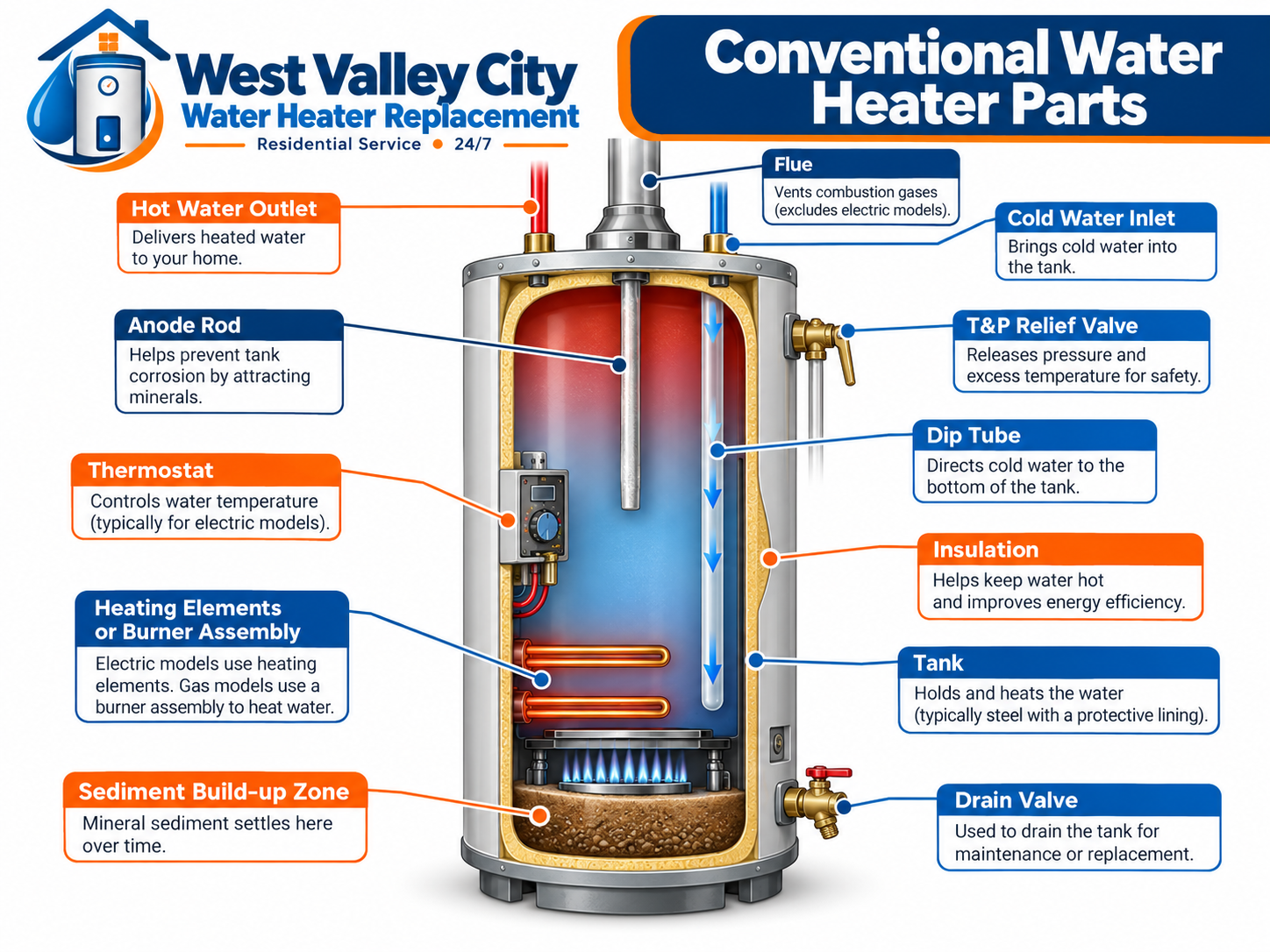
A reliable replacement is more than swapping cylinders. Capacity, fuel, venting, pressure, drainage, access, and the household's real hot-water habits all affect the recommendation.
A repair can be worthwhile on a younger, sound tank. Replacement becomes more likely when age, leakage, corrosion, and repeat failures begin to overlap.
A loose fitting can be repairable. Seepage through the tank body usually means the inner vessel has failed.
Long recovery, temperature swings, or shorter showers can signal sediment, failed controls, or lost capacity.
Standard tanks often serve 8–12 years. Repeated repairs on an older tank can cost more than planning ahead.
Mineral buildup can trap water against heated surfaces, causing noise and reducing heat transfer.
Rust-colored hot water, corroded fittings, or deterioration around the jacket deserves prompt attention.
Recurring gas-control, ignition, thermostat, or element problems should be weighed against the unit's age.
A useful estimate accounts for the entire installed scope—not just the equipment price.
Standard residential tank replacements commonly plan around $1,600–$3,200. Tankless projects often plan around $3,800–$7,500+. Actual pricing depends on the home, fuel, access, capacity, and required updates.
Build a personalized planning range| Typical project | Planning range |
|---|---|
| Standard electric tank | $1,500–$2,800 |
| Standard gas tank | $1,700–$3,200 |
| Tankless replacement | $3,800–$6,200 |
| Tank-to-tankless conversion | $5,000–$8,500+ |
There is no universal winner. The best fit matches your utilities, peak hot-water use, space, budget, and maintenance expectations.
Gas tanks often offer faster recovery but require safe combustion and venting. Electric tanks avoid combustion venting but need the proper dedicated circuit.
Tanks offer familiar, economical replacement. Tankless systems save floor space and heat on demand, but conversions can require substantial utility changes.
A 40- or 50-gallon label does not tell the whole story. First-hour rating, recovery speed, fixtures used together, and incoming water temperature shape real comfort.
Every home is different, but a careful replacement follows a disciplined sequence.
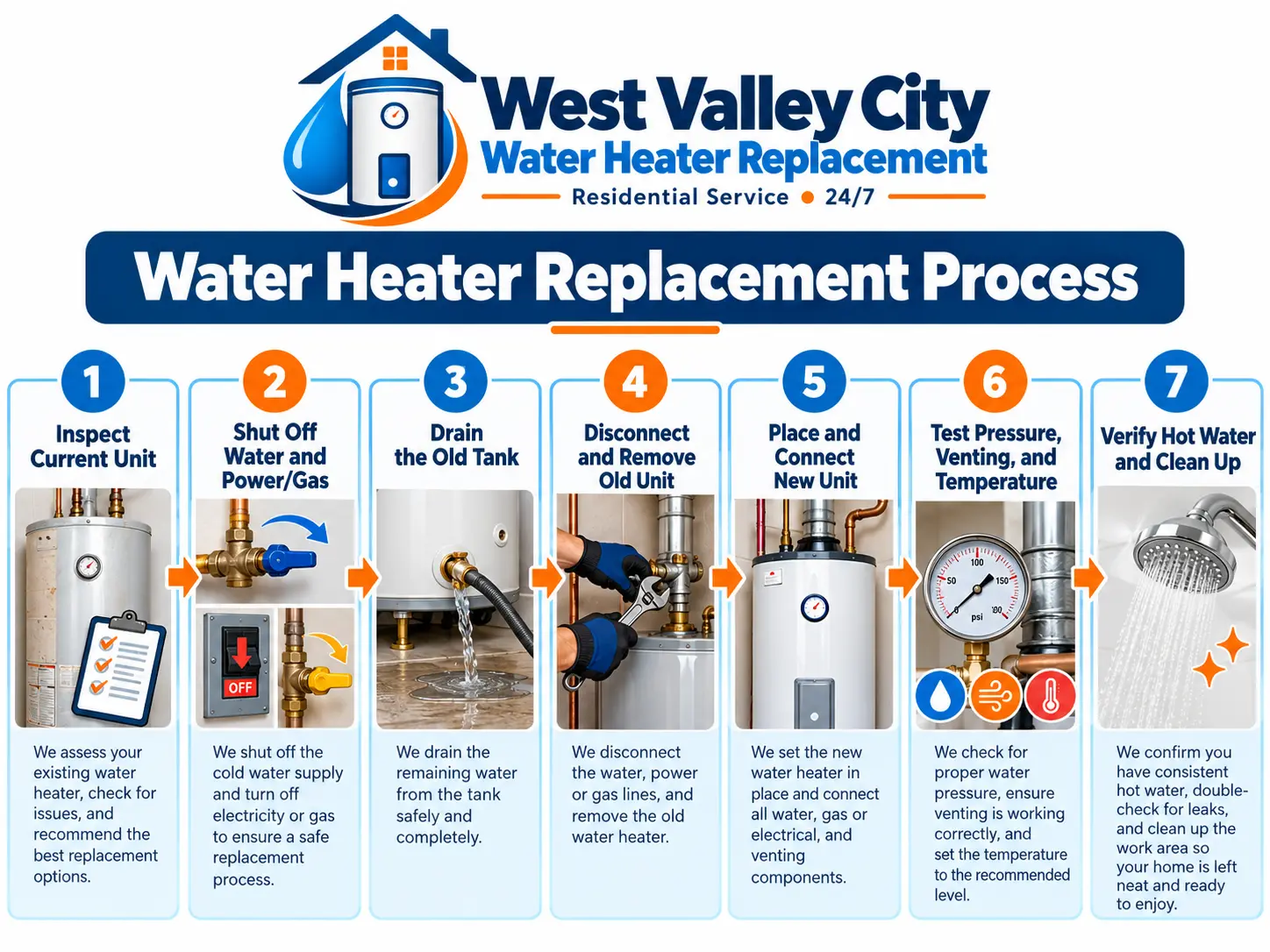
Confirm failure, fuel, capacity, access, and practical replacement choices.
Shut off water and the gas or electrical supply before draining.
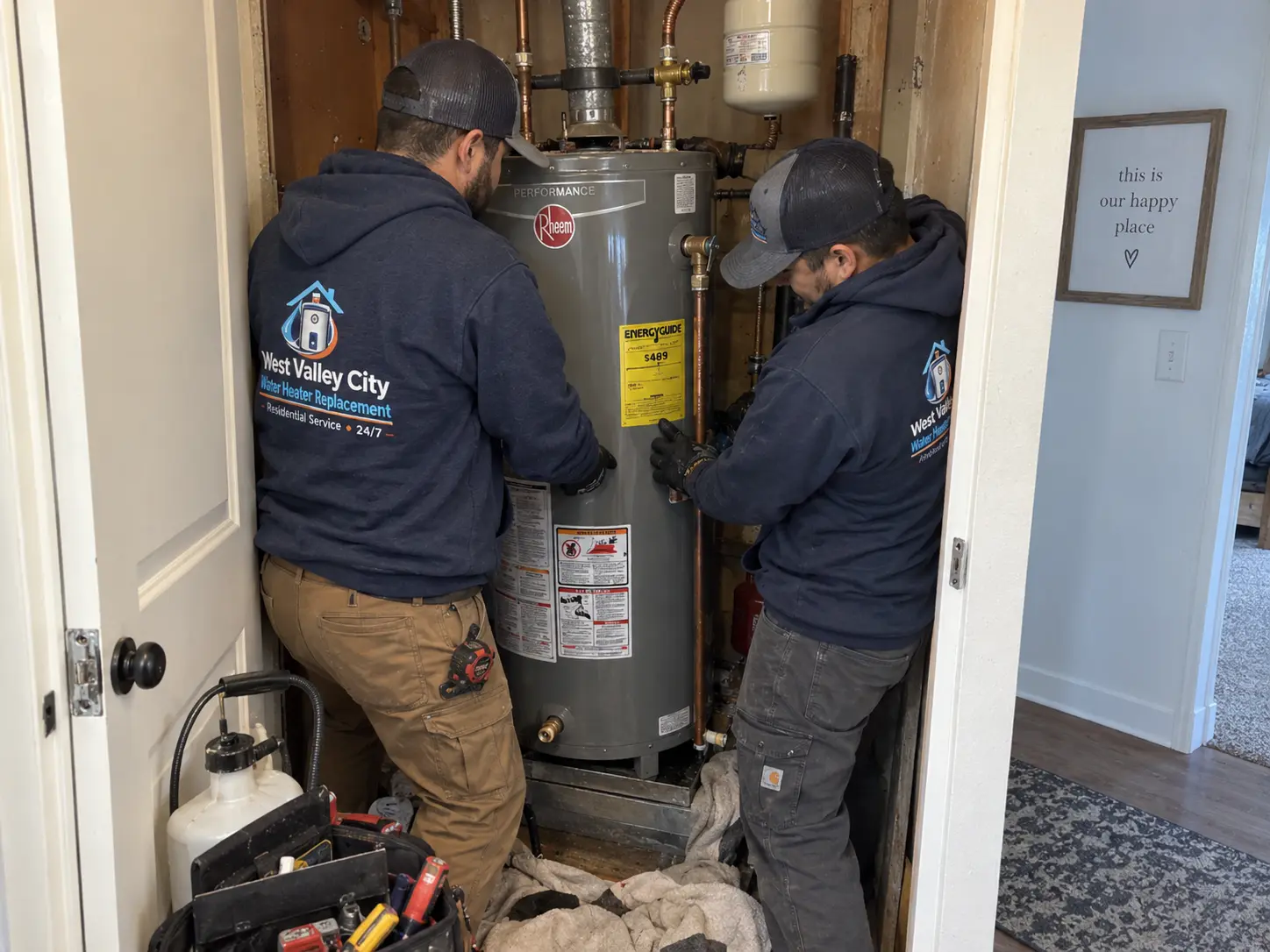
Remove the old unit and complete approved water, fuel, vent, and safety connections.
Check pressure, operation, temperature, leaks, venting, and the work area.
24/7 residential availability
Tell us what is happening and have your five-digit ZIP code ready. We’ll confirm current residential service availability and next steps.
Residential scheduling is available throughout West Valley City—from Granger and Hunter to Chesterfield and neighborhoods near the 5600 West corridor—and in nearby communities.
Service availability depends on the day, ZIP code, equipment, and installation needs. View the complete service area guide.
Gas replacement requires attention to combustion air, connectors, shutoffs, draft, and vent condition—not just tank size.
Installed cost changes with capacity, access, venting, code updates, expansion control, permits, and haul-away.
The best choice is correctly sized, compatible with the home's utilities, safely installed, and supported by clear warranty terms.
Electric replacements require correct circuit capacity, overcurrent protection, disconnecting means, wiring, and element configuration.
Get homeowner-friendly answers about price, lifespan, timing, leaks, hard water, permits, expansion tanks, and more.
A straightforward residential tank replacement often falls around $1,600–$3,200, while tankless projects commonly range from about $3,800–$7,500 or more. Fuel type, capacity, access, venting, permit or code work, expansion control, and haul-away affect the final quote.
Many like-for-like tank replacements take roughly two to five hours after the correct unit is on site. Tight access, venting changes, conversions, permit steps, or tankless work can take longer.
Repair may make sense for a serviceable control, thermostat, element, or valve on a younger tank. Replacement becomes more sensible when the tank body leaks, corrosion is advanced, failures repeat, capacity is inadequate, or the unit is near the end of its expected life.
Yes. Residential gas and electric systems require different utility, venting, electrical, and safety checks. The existing home setup usually guides the simplest replacement path.
Tankless replacement and conversion options can be evaluated. A conversion may require gas-line, venting, condensate, electrical, or water-treatment changes, so an on-site review matters.
Common tank sizes are 40 and 50 gallons, but household size alone is not enough. Consider peak simultaneous use, first-hour rating, recovery speed, available space, fuel, and future needs.
Choose tank style, fuel, capacity, installation complexity, venting, expansion control, permit considerations, haul-away, and scheduling needs.
Practical local reading for deciding, budgeting, and responding safely.
A practical guide to residential water heater replacement costs, price factors, and quote questions for West Valley City homeowners.
Read guideLearn the warning signs of a failing residential water heater before a leak or no-hot-water emergency.
Read guideCompare gas and electric residential water heaters by recovery, installation needs, efficiency, and home compatibility.
Read guideA few practical details help us understand the urgency and identify likely replacement options.